

Do You Know How To Choose a Wheel barrow
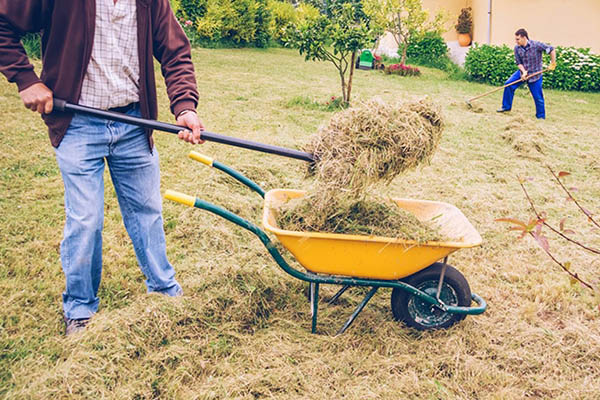
If you’ve ever come across a wheelbarrow in your day, you pretty much know the basics. They feature a basin in which to hold stuff, two long handles, legs of some type on which to rest when it isn’t being moved, and a wheel up front.This is basically your standard style, and you’ve probably seen it with the wheel pushed toward the end. With this style, the weight is distributed evenly between the barrow and the person pushing it. Some types have the wheel more toward the center, which puts all the weight on the barrow. This center-wheel style is seen more in the Asian countries.
WHEELBARROW TYPES
Wheelbarrows come in a few different body styles, handle styles and wheel styles, and each can offer different benefits depending on what your work is.
BASIN MATERIALS
There are three common types of materials used to create the basin of a wheelbarrow, and each has some unique benefits.
1. PLASTIC
A plastic basin is much lighter than one of the metal options. This is obviously pretty important, depending on the materials you’re trying to move. Additionally, plastic doesn’t have the corrosion issues which are inherent with metal materials.Because of this, plastic wheelbarrows are good for moving materials such as fertiliser or animal manure. They also don’t rust and some moving materials don’t stick to them. Transporting concrete in a wheelbarrow, for instance, is good because if it happens to dry on, it can be removed somewhat easily.
2. GALVANISED STEEL
Though still susceptible to rusting, galvanised steel is a good alternative to plastic because it is much sturdier. If you’re moving heavy materials like bricks or stones, galvanised steel is going to hold up a bit better as it won’t bend or bow.Unlike plastic, steel can stand up better to years in the sunlight, whereas plastic can weaken from constantly being hit by UV rays. Certain materials can also damage plastic in ways steel wouldn’t have any issue.
3. POWDER COATED STEEL
Really, this has almost all the same qualities as galvanised steel, it just looks a bit nicer. It is, however, susceptible to being scratched if you’re moving sharp or pointed materials.
WHEEL TYPES
Much the same as with the basins of wheelbarrows, there are three different types of wheels you’re likely to find, each of which has a different use. I’ve seen arguments for each of the varieties, but it seems much of it comes down to the job and to your level of maintenance on the wheelbarrow.
Pneumatic
An inner tube provides the support when it comes to pneumatic tires. Just as with a bicycle tire, pneumatic tires have a hard rubber outside with a tube inside which is filled with air. Also as with a bicycle tire, pneumatic tubes are more sensitive to puncturing or going flat over time.
Even so, they offer a smoother experience than some other options. Since they have more give to them, using them on uneven surfaces is going to work pretty well. You’ll just need to make sure you’re paying attention to your tires to see their quality from time to time.
Solid Rubber
Without a tube inside them, there’s no way for a solid rubber tire to get flat. You can stab it, cut it, do pretty much whatever you want to it, and it isn’t going to go flat. However, it has way more bounce than pneumatic tire. So, you’ve got a bit of a trade off. You’ll not get any flats, but if you’re moving over rocks or any other sort of super bumpy area, you’re likely to find your wheelbarrow bouncing around and your load flying all over the place.
Semi-pneumatic
This is a middle-of-the-road type of tire in that it blends the two types. It doesn’t need to be inflated, but it does have pockets of air inside a hard rubber tire. With this, you’re going to have a bit more of a smoother ride than with a hard rubber tire.
HANDLE MATERIALS
Most commonly you’ll find either steel handles or wooden handles on a wheelbarrow. You’ll find the reasoning for these options is similar to that of the basin. Steel handles resist rust, are very strong and are unlikely to break over time.Wooden handles, however, don’t rust at all, are a bit more comfortable than steel and have a bit of flex to them. The flex is nice as it helps better reduce additional strain on the upper body when moving multiple loads.